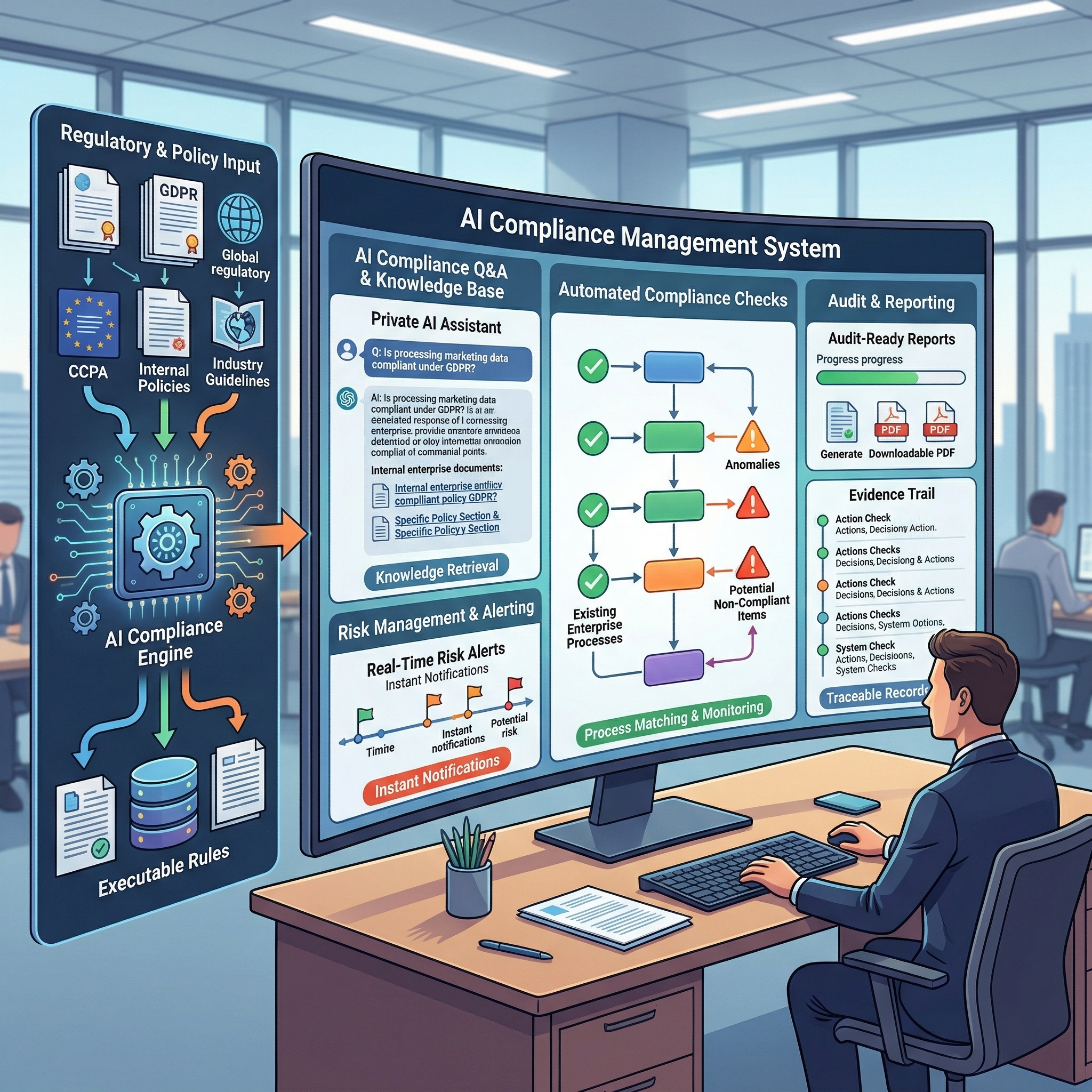
AI Compliance Management System | Automated Compliance Monitoring, Policy Management and Audit Evidence Platform

AI Compliance Management System

AI Does Not Just Answer Policy Questions, but Helps Enterprises Build an Executable, Traceable, and Auditable Compliance Management System


The AI Compliance Management System provides enterprises with a human-centered compliance intelligence platform that helps teams interpret regulations more effectively, manage policies, perform compliance checks, track risks, and prepare audit evidence, so compliance work no longer relies only on manpower and scattered documents.

Through the Human First AI design philosophy, the AI Compliance Management System is not just a tool for searching policy information. It integrates policy interpretation, knowledge management, RAG retrieval, compliance monitoring, evidence logging, and system integration into one secure, controllable, and governable enterprise platform.

The AI Compliance Management System helps enterprises transform complex regulations, internal policies, process requirements, and audit evidence management into intelligent compliance workflows that are executable, monitorable, and continuously updatable.

Omnisenti AI


What Can the AI Compliance Management System Do?


Through the AI Compliance Management System, enterprises can turn regulatory and policy requirements into a compliance management platform that can be interpreted, applied, monitored, and tracked, reducing manual judgment errors while improving the ability to respond to regulatory and audit requirements.

  • Transform regulations, policies, and guidelines into structured, executable rules
  • Provide Private AI compliance Q&A and internal knowledge retrieval
  • Provide more accurate answers based on enterprise documents, policies, and compliance requirements
  • Perform automated compliance checks and process matching
  • Instantly flag risks, anomalies, and potential non-compliant items
  • Generate audit-ready reports and traceable evidence records

How the AI Compliance Management System Works


1. Import Regulations, Policies, and Internal Documents

Enterprises can import policy manuals, regulatory documents, operating guidelines, compliance procedures, and departmental rules into the system to build a dedicated compliance knowledge foundation.

2. Convert Them into Executable Rules and Knowledge Content

AI Comply transforms complex regulatory and policy content into structured, applicable rules for daily comparison, checks, and Q&A use.

3. Provide Private AI Compliance Q&A and Retrieval

SmartAsk combines RagTag and Sheshata, allowing teams to use natural language to query policies, systems, procedures, and regulatory requirements, and quickly obtain answers that are more aligned with enterprise content.

4. Apply Permission and Governance Rules

GateKippa controls data and function access according to department, role, and authorization scope, ensuring sensitive content is accessed and circulated only within approved boundaries.

5. Perform Compliance Checks and Exception Alerts

The system can perform checks according to policy rules and process requirements, and instantly flag anomalies, omissions, risks, or potential non-compliant items.

6. Generate Evidence, Reports, and Traceable Records

The AI Compliance Management System can produce audit reports, inspection records, process logs, and evidence materials required for audits, making it easier for enterprises to respond to regulatory and internal review requirements.
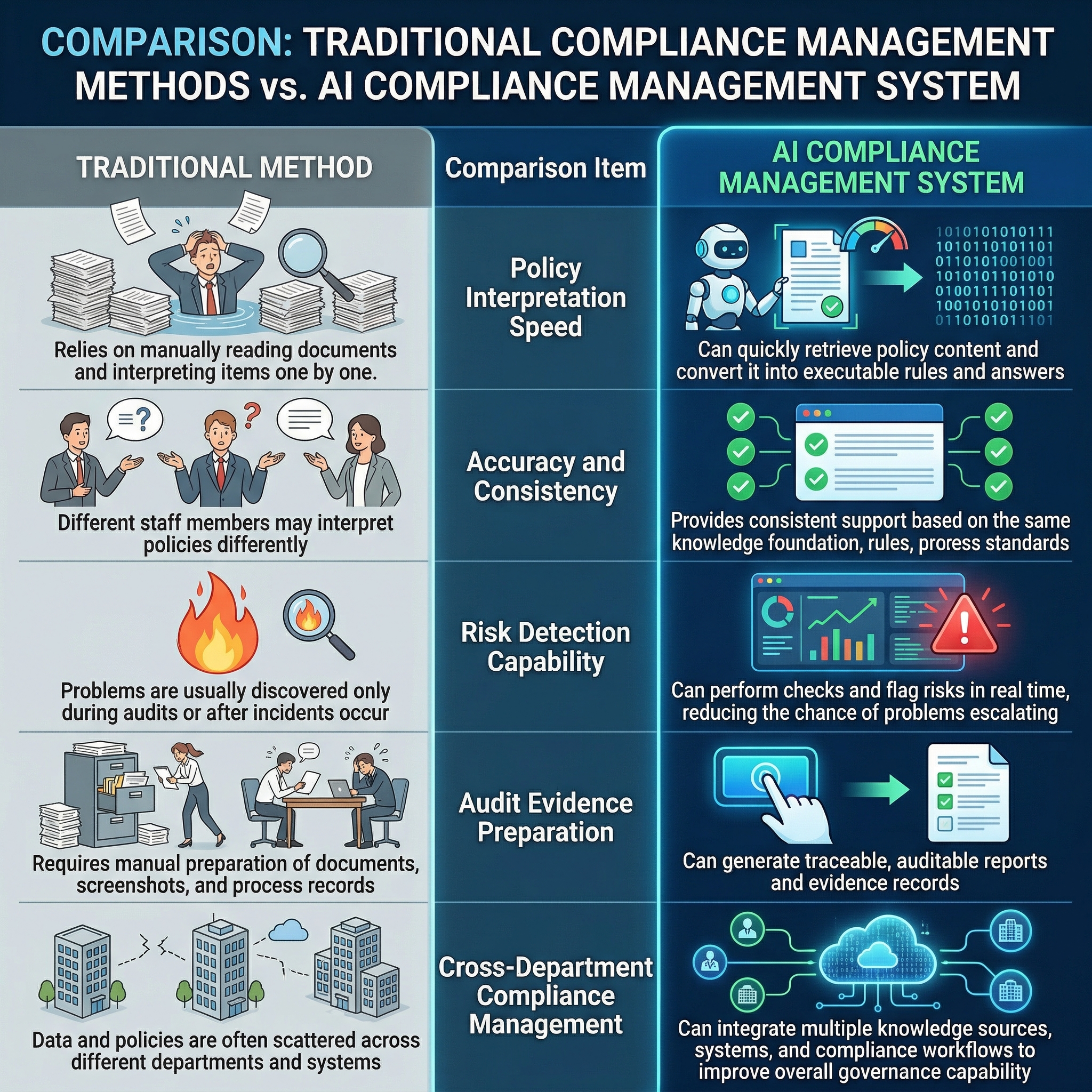

AI Compliance Management System vs Traditional Compliance Management Methods

Comparison Item
Traditional Method
AI Compliance Management System
Policy Interpretation Speed
Relies on manually reading documents and interpreting items one by one, so processing takes longer.
Can quickly retrieve policy content and convert it into executable rules and answers.
Accuracy and Consistency
Different staff members may interpret policies differently.
Provides consistent support based on the same knowledge foundation, rules, and process standards.
Risk Detection Capability
Problems are usually discovered only during audits or after incidents occur.
Can perform checks and flag risks in real time, reducing the chance of problems escalating.
Audit Evidence Preparation
Requires manual preparation of documents, screenshots, and process records, which takes longer.
Can generate traceable, auditable reports and evidence records.
Cross-Department Compliance Management
Data and policies are often scattered across different departments and systems.
Can integrate multiple knowledge sources, systems, and compliance workflows to improve overall governance capability.

AI Compliance Management System

Core AI Architecture and Component Modules


The AI Compliance Management System is composed of multiple core technologies from Omnisenti AI, ensuring that the platform is not only for policy lookup, but also has complete capabilities in Private AI, knowledge management, compliance checks, RAG retrieval, permission governance, system integration, and audit evidence handling.

GateKippa|AI Access and Permission Management

GateKippa manages usage permissions for the AI system, ensuring compliance data, policy documents, audit records, and sensitive content are used only within authorized scopes. It supports role-based permission management, AI model usage restrictions, operation audit logs, single sign-on (SSO), and automatic account management.

Sheshata|Enterprise Compliance Knowledge Base Management

Sheshata allows enterprises to manage AI knowledge content on their own, including policy documents, internal rules, operating guidelines, audit requirements, and version updates. It supports document upload, classification, version tracking, real-time updates, and edit permission control.

RagTag|RAG Knowledge Retrieval and Answer Enhancement

Through Retrieval-Augmented Generation (RAG) technology, RagTag injects relevant regulations, policies, and enterprise document content into answer and checking processes, improving answer accuracy and reducing AI hallucination issues.

SmartAsk|Private AI Compliance Knowledge Assistant

SmartAsk is a dedicated Private AI for enterprises. It uses internal policies, guidelines, and knowledge documents to provide fast, accurate, and contextual answers. It supports natural language queries, private deployment, compliance security requirements, and multi-channel access, making it especially suitable for privacy- and compliance-sensitive institutions such as finance, legal, healthcare, and education.

Fuse|AI Platform and Compliance Workflow Coordination Core

Fuse integrates internal enterprise systems, knowledge sources, and compliance workflows, coordinating queries, checks, notifications, evidence output, and workflows, so that AI compliance capability is not just knowledge Q&A but can truly be embedded into daily management processes.

AI Comply|Automated Compliance Intelligence Engine

AI Comply transforms complex regulations and policies into structured, executable rules, supporting automated compliance checks, real-time risk alerts, compliance assessment, and audit-ready report generation, helping enterprises manage regulatory requirements and governance responsibilities more efficiently.


Integration Capabilities: Policy / Knowledge / Workflow / Systems / Audit


Policy and Regulatory Document Integration

The platform can integrate regulatory texts, policy manuals, internal rules, audit requirements, and operating documents to build a continuously updatable compliance knowledge foundation.

Private AI Compliance Knowledge Integration

Through SmartAsk, Sheshata, and RagTag, teams can use natural language to query enterprise policies, system requirements, and regulatory content, and obtain answers that are more aligned with real-world situations.

Internal Process and System Integration

Through Fuse, the platform can connect existing enterprise systems, workflows, and knowledge sources, integrating compliance checks with daily processes.

Audit Evidence and Report Integration

The system can organize inspection records, exception alerts, evidence logs, and auditable reports, improving efficiency in responding to regulatory and internal reviews.

Permission and Governance Integration

The platform can set permissions according to department, role, data sensitivity, and policy requirements, ensuring the use of compliance data is controllable, traceable, and auditable.
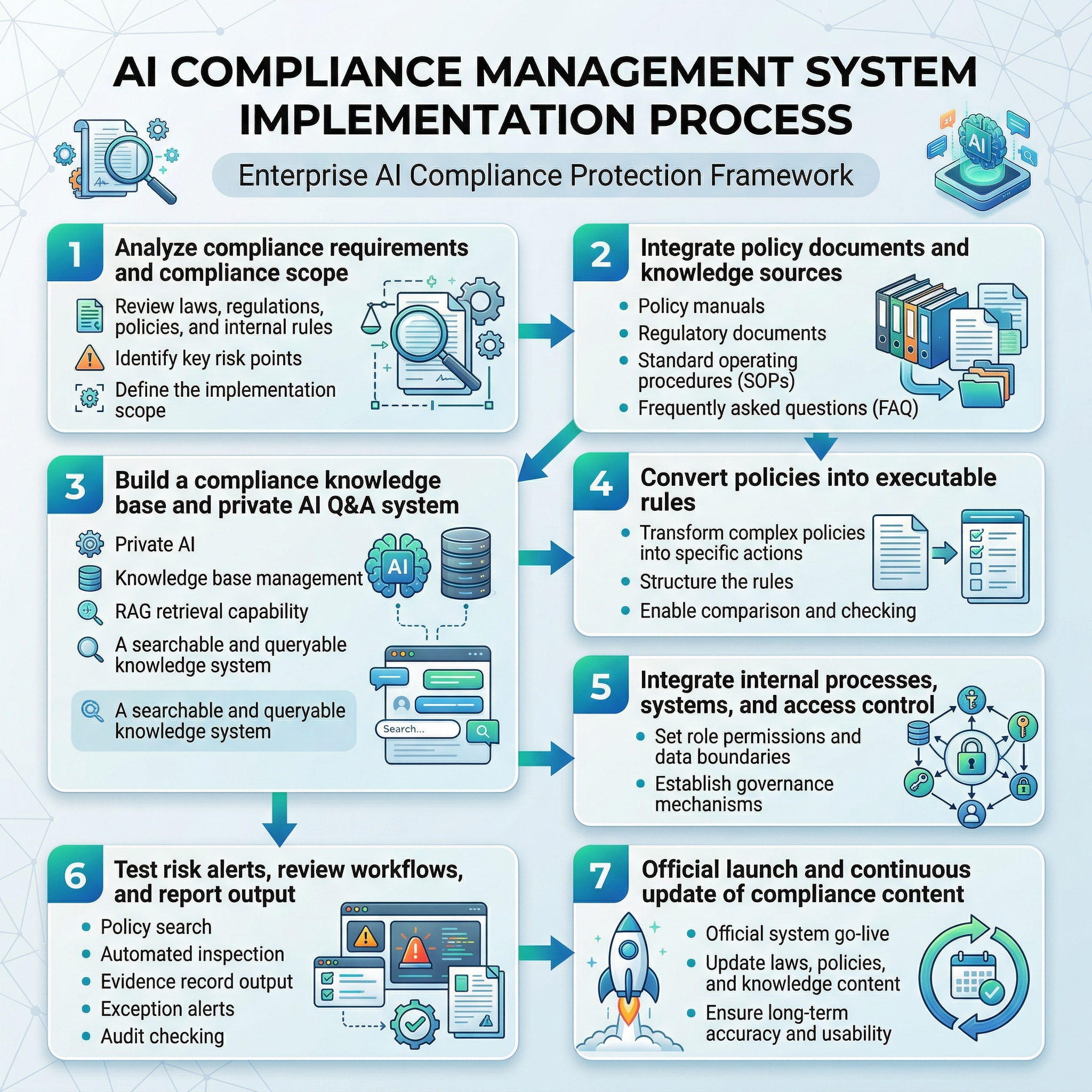

AI Compliance Management System Implementation Process

AI Compliance Management System
Step 1

Analyze Regulatory Requirements and Compliance Scope

First organize the regulations, policies, internal rules, and risk priorities that the enterprise needs to comply with, and clearly define the scope of implementation.

Step 2

Integrate Policy Documents and Knowledge Sources

Integrate policy manuals, regulatory documents, SOPs, FAQs, and related materials into the enterprise compliance knowledge foundation.

Step 3

Build a Compliance Knowledge Base and Private AI Q&A

Through Private AI, knowledge base management, and RAG retrieval capabilities, build a compliance knowledge system that can be queried and referenced.

Step 4

Convert Policies into Executable Rules

Transform complex regulations and policy content into structured, comparable, and checkable rules.

Step 5

Integrate Internal Processes, Systems, and Permission Management

Connect compliance requirements to existing processes and systems, while configuring role permissions, data boundaries, and governance mechanisms.

Step 6

Test Risk Alerts, Checking Workflows, and Report Output

Test whether policy queries, exception alerts, automated checks, and audit evidence output meet actual needs.

Step 7

Officially Deploy and Continuously Update Compliance Content

After the system goes live, continuously update regulations, policies, and knowledge content to ensure the AI Compliance Management System remains accurate and usable over the long term.

Key Business Value


  • Reduce Compliance Risks: Detect issues and potential anomalies earlier, reducing the chance of risks escalating.
  • Save Manpower and Time: Reduce time spent on manual policy review, knowledge searches, and report preparation.
  • Improve Accuracy: Reduce judgment errors caused by differences in manual interpretation.
  • Increase Audit Confidence: Respond to audit requirements with clear, traceable evidence and reports.
  • Strengthen Knowledge Application: Transform policies, systems, and regulations into intelligent support that can actually be used.
  • Maintain Security and Governance: Use AI compliance capabilities under permissions, logging, and private deployment conditions.

Applicable Scenarios


Financial Institutions and Insurance Industry

Can be used for AML / KYC, reporting requirements, internal controls, policy comparison, and regulatory knowledge management.

Healthcare and Health Service Organizations

Suitable for managing policies, patient data handling requirements, privacy, and institutional compliance scenarios.

Legal and Professional Service Teams

Can be used for compliance knowledge retrieval, policy reference, document comparison, and traceable evidence organization.

Human Resources and Corporate Governance

Suitable for managing internal policies, employee codes, workplace safety, data governance, and internal audit requirements.

Large Enterprises and Multi-department Organizations

Suitable for enterprises where knowledge is fragmented, policies are numerous, and cross-department collaboration and continuous compliance updates are required.


Frequently Asked Questions

An AI Compliance Management System is an AI platform that helps enterprises interpret regulations, manage policies, perform compliance checks, generate audit evidence, and continuously track compliance risks.

A general knowledge base or Chatbot mainly provides information search and Q&A. In addition to Q&A, the AI Compliance Management System can also convert regulations and policies into rules, perform compliance checks, flag risks, and generate auditable evidence and reports.

Yes. Through SmartAsk, Sheshata, and RagTag, the system can provide answers that are more aligned with actual situations based on internal enterprise policies, rules, guidelines, FAQs, and document sources.

No. Through GateKippa, the system can set permission management, access control, audit records, and model usage restrictions, and can work with private deployment or private cloud architecture to ensure sensitive data is used only within authorized scopes.

Yes. AI Comply can perform checks according to policy rules and process requirements, and instantly flag anomalies, risks, omissions, or potential non-compliant items.

Yes. The system can generate audit-ready reports, inspection records, compliance evidence, and traceable process logs, helping enterprises respond more effectively to regulatory and audit requirements.

It is especially suitable for institutions such as finance, insurance, legal, healthcare, education, HR governance, and large enterprises that need to manage large volumes of policies, audit requirements, or highly sensitive data.

No. SMEs can also start with a single compliance scenario, a single policy library, or a single department, and gradually build a more complete compliance governance capability.

Yes. The AI Compliance Management System does not replace the compliance team. It helps them reduce repetitive review work, improve policy retrieval efficiency, reduce human error, and produce auditable results faster.

It depends on the number of policy documents, the integration scope, and workflow complexity. Generally, enterprises can start with knowledge retrieval, policy Q&A, or a single compliance check scenario, and then gradually expand to more systems and policies.

Main Capabilities of the AI Compliance Management System

Policy and Regulation Rule Structuring

Transform regulations, policies, and guidelines into executable, applicable rules.

Private AI Compliance Q&A

Provide more accurate and secure compliance answers based on enterprise documents and policies.

RAG Knowledge Retrieval and Policy Reference

Extract relevant content from multiple policy sources and internal documents to support judgment.

Automated Compliance Checks

Automatically perform checks and comparisons based on policy rules and internal processes.

Real-time Risk Alerts

Quickly flag anomalies, omissions, and potential compliance issues.

Audit Evidence and Report Generation

Automatically organize auditable, traceable compliance evidence and report content.

System and Workflow Integration

Connect policy knowledge, internal workflows, and existing systems together.

Permission Governance and Data Security

Control data access by role and authorization scope to keep it controllable and compliant.