
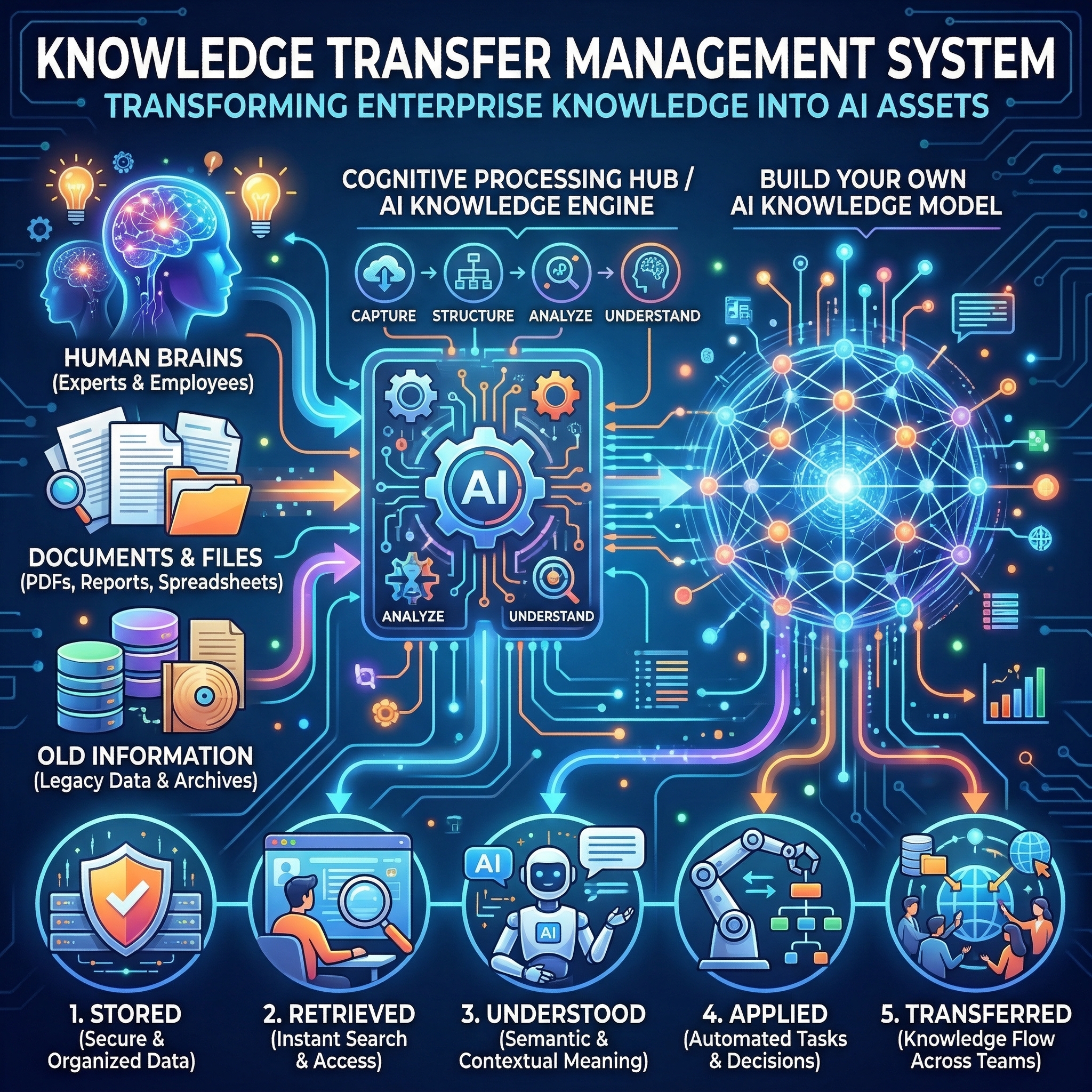
For many enterprises, the most important assets are not just customer lists or systems, but the knowledge hidden in employee experience, internal documents, SOPs, old cases, departmental practices, and management judgment.
When key employees leave, senior staff retire, departments reassign people, or process handovers are incomplete, what enterprises are most likely to lose are often these knowledge assets that are not immediately visible but are extremely valuable.
As Omnisenti Human First AI’s deployment partner in the Greater Bay Area, GoPeople helps enterprises build their own AI models, turning internal knowledge, working methods, process rules, case experience, and departmental intelligence into an AI knowledge system that can be searched, managed, transferred, and continuously evolved.
The core of a Knowledge Continuity Management System is not just building a knowledge base, but helping enterprises build their own AI knowledge model so that knowledge is not only stored, but can also be searched, understood, applied, and passed on.Omnisenti AI carried by GoPeople
Core knowledge and experience assets
Find answers quickly with natural language
Reduce knowledge gaps caused by staff turnover
Omnisenti emphasizes Human First AI. Human First AI does not mean directly inserting AI into the enterprise. It means first understanding how people work, how knowledge is formed, how processes operate, and how departments collaborate, then building AI on top of those real needs.
Our AI service does not use AI to replace experienced people. Instead, it helps enterprises preserve people’s experience, methods, judgment, and knowledge, so new colleagues can take over more quickly, existing knowledge can continue more easily, and the overall capability of the team no longer depends only on a few individuals.
People are always the most important element. AI is not here to replace people, but to help enterprises retain knowledge, organize it well, and pass it on, so the team’s overall capability can accumulate instead of being lost because of staff turnover.
Omnisenti Human First AI provides Private AI, Knowledge AI, Guard Rails, Ethical AI, and governable AI architecture capabilities, making it suitable for building enterprise-dedicated AI knowledge models and knowledge management platforms.
As the Greater Bay Area deployment partner, GoPeople helps enterprises transform knowledge management from “document accumulation” into a searchable, usable, and transferable AI knowledge platform based on different industry processes, departmental operations, business logic, and real management needs.
Build an AI model for the enterprise itself, allowing AI to provide support based on internal enterprise knowledge, documents, experience, and processes.
Organize documents, SOPs, cases, FAQs, emails, internal notes, policies, and departmental practices into manageable knowledge assets.
Employees can use natural language to search for processes, policies, past cases, handling methods, and internal knowledge, greatly reducing the time spent “asking others” and “looking for information.”
Retain the experience of senior employees, departmental habits, practical judgment, and handling logic to support new employee onboarding, role handovers, and departmental continuity.
Set different permissions according to department, role, and data sensitivity, ensuring that knowledge search and model output are carried out within safe and controllable boundaries.
Establish output boundaries, auditable usage methods, and knowledge update rules to ensure the AI knowledge system remains manageable over the long term.
Can integrate with internal document systems, CRM, ERP, knowledge bases, email, internal platforms, and enterprise data sources, so the knowledge model is truly connected to daily work.
First understand which knowledge is currently the most important, the easiest to lose, and the scenarios that most urgently need continuity.
Organize documents, SOPs, cases, FAQs, emails, departmental experience, and internal practices into a knowledge foundation.
Create an AI model that belongs to the enterprise itself based on its knowledge content and departmental logic.
Define different knowledge access scopes and usage boundaries according to department, role, and data sensitivity.
Connect the knowledge model into document systems, knowledge bases, CRM, ERP, or other internal platforms.
Test search results, knowledge accuracy, and real-world usage, then continuously optimize the model and content.
After launch, gradually expand into more departments, more knowledge scenarios, and more continuity needs.