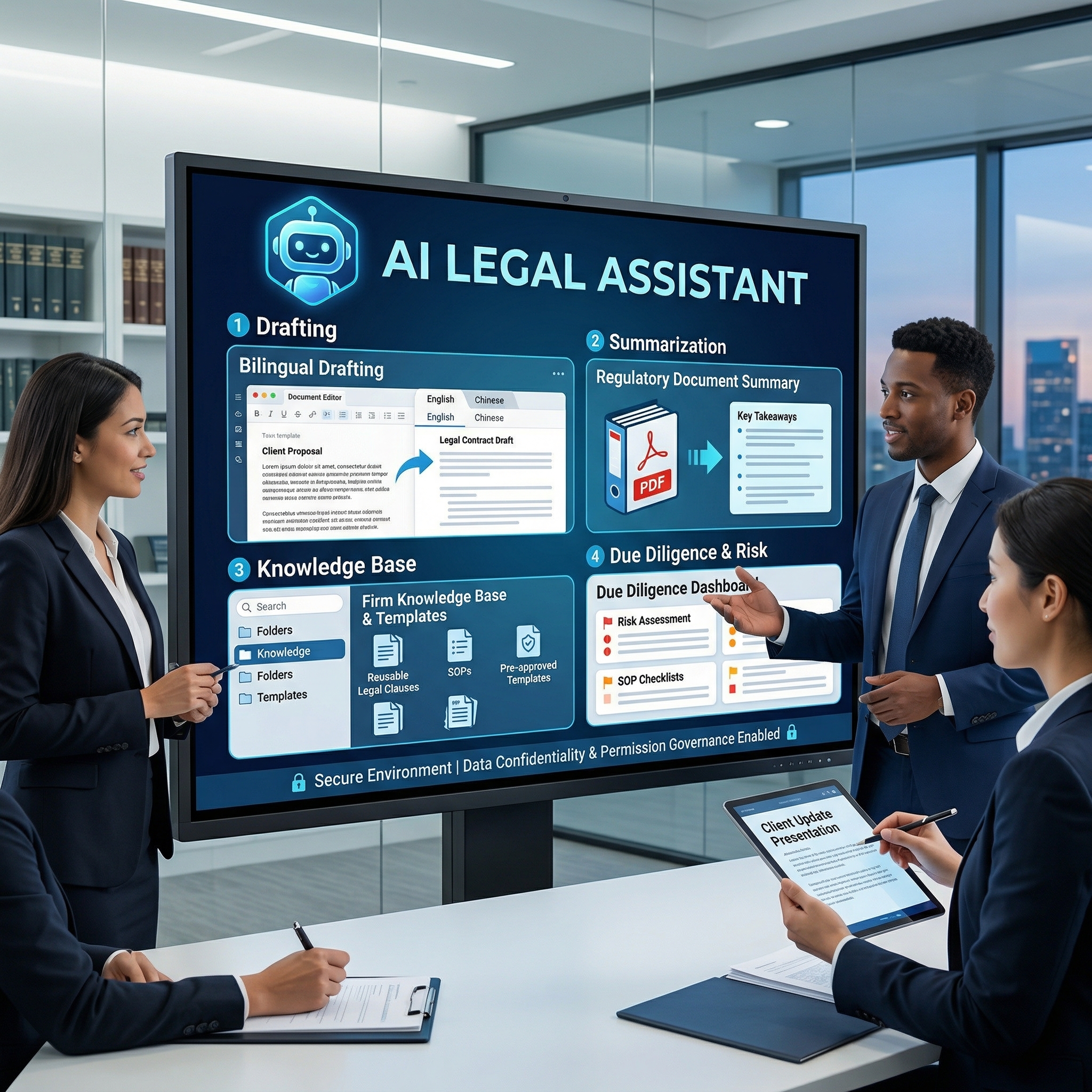
An AI Document, Research, and Knowledge Work Platform Designed Specifically for Hong Kong Law Firms
From proposal drafting, long-document research, and due diligence summaries to internal knowledge retrieval, client presentations, and training material creation, GoPeople AI Legal Assistant transforms a large volume of time-consuming, repetitive, non-billable knowledge work into executable, manageable, and traceable AI intelligent workflows.
Designed specifically for the confidentiality requirements, document style, and compliance needs of Hong Kong law firms, it helps teams reduce non-billable time, improve lawyer productivity, accelerate client response times, and achieve measurable returns within 6-9 months.
AI Legal Assistant is not a single writing tool, but an AI work platform that integrates proposals, research, knowledge management, presentations, and compliance governance, allowing law firms to truly shift time away from inefficient knowledge-processing work and back toward high-value legal services.
OMNISENTI AI
A Law Firm’s Most Valuable Asset Is Not Documents, but Billable Time
Hong Kong law firms handle a large amount of highly knowledge-intensive yet highly repetitive work every day: drafting proposals and first drafts of legal documents, researching lengthy regulations and cases, reviewing hundreds of pages of PDFs and market reports, organizing internal templates and historical knowledge, creating client presentations and internal training materials, and responding to client progress updates and professional explanations.
Although this work is necessary, a large portion of the time does not directly create billable value, but instead compresses the time lawyers can devote to truly high-value analysis, negotiation, advisory work, and client service.
- Partners spend a large amount of time revising proposals and documents
- Junior lawyers repeatedly search for provisions, cases, and past templates
- Research and due diligence take too long
- Clients wait too long for proposals and responses
- Presentation and training material preparation depends too heavily on manpower
- Internal knowledge is difficult to reuse, and teams frequently repeat the same labor
What Can AI Legal Assistant Do?
AI Legal Assistant transforms the common time-intensive knowledge work of law firms into faster, more accurate, and more reusable intelligent workflows:
- Quickly generate bilingual proposals, reports, and first drafts of legal documents
- Summarize regulatory documents, cases, long PDFs, and market research reports
- Build an internal knowledge and template library that can be searched and reused
- Generate due diligence summaries, risk lists, and SOP checklists
- Quickly turn written content into client presentations and training materials
- Use AI work capabilities safely under confidentiality and permission governance
70-80%↓
Reduction in non-billable time
35-45%↑
Increase in lawyer productivity
6-9 months
Average ROI payback period
Value One: AI Document and Proposal Automation
AI Legal Assistant can quickly generate bilingual proposals, draft reports, first drafts of legal documents, fee structure explanations, client update content, and internal work summaries based on client context, service scope, key points, and the law firm’s existing style.
Lawyers only need to review and fine-tune the high-quality drafts generated by AI, rather than repeatedly writing from scratch, allowing time to be focused on professional judgment and strategy.
- Proposal and report preparation time reduced by 75-80%
- Each lawyer gains an average of 2-3 more billable hours per day
- Faster client response times
- Higher proposal submission efficiency
- Helps improve win rates and client satisfaction
Value Two: AI Research Summarization and Knowledge Management
AI Legal Assistant helps lawyers quickly process a large volume of high-density content, such as regulatory documents, lengthy PDFs, market research reports, past cases, internal templates, historical proposals, and new client onboarding documents.
The system can automatically extract key provisions, risk highlights, business opportunities, comparison summaries, and structured key points. It also allows lawyers to directly query internal knowledge questions and quickly get usable results.
- Research time reduced from 8-10 hours to 1-1.5 hours
- Due diligence and research time reduced by more than 80%
- Knowledge reuse rate increased by 85%
- Junior lawyers spend less time on repetitive searching
- Senior lawyers can focus on high-value analysis
Value Three: AI Presentation and Training Material Generation
AI Legal Assistant can quickly turn proposal text, research content, or case summaries into client PowerPoint presentations, risk matrices, timelines, key charts, internal training materials, and meeting presentation content.
This is especially important for law firms because many high-value client meetings and training projects often require high-quality, clearly structured, and visually professional presentation formats.
- Presentation production time reduced by 85%
- Client meeting preparation speed increased by 6-7 times
- Presentations become clearer and more persuasive
- Internal training materials become easier to standardize
- Helps win mid-to-large corporate clients and training projects
AI Legal Assistant vs Traditional Legal Knowledge Work Model
Comparison Item
Traditional Method
AI Legal Assistant
Proposal and Document Drafting
Lawyers manually organize key points, find templates, write paragraph by paragraph, and revise repeatedly. It is time-consuming and highly dependent on individual experience.
Can quickly generate bilingual proposals, reports, and drafts in the firm’s style, allowing lawyers to focus on review and fine-tuning.
Research and Due Diligence
Requires page-by-page reading of lengthy regulations, cases, and PDFs, and takes a long time to organize summaries and risk lists.
Can extract key provisions, risks, summaries, and checklists, significantly reducing research time.
Knowledge Reuse
Past cases, proposals, and templates are scattered across different files and personal memory, making them difficult to reuse quickly.
Can turn internal knowledge, templates, and cases into searchable and reusable knowledge assets.
Client Presentations and Training Materials
Requires manual reorganization of text into presentations and teaching materials, which is time-consuming and difficult to keep consistent in format.
Can quickly turn text into professional presentations, risk matrices, timelines, and training materials.
Billable Time Utilization
A large amount of time is spent on non-billable, repetitive, and basic organizing work, compressing time for high-value services.
Compresses non-billable work so lawyers can devote more time to analysis, strategy, and client service.
Which Law Firms Are Best Suited for Implementation?
Law Firms with High Proposal and Business Development Workloads
Need to frequently prepare client proposals, service proposals, and presentation materials.
Teams with Intensive Research and Due Diligence Work
Frequently handle lengthy regulations, cases, transaction documents, and risk summaries.
Law Firms That Value Knowledge Management and Template Reuse
Want to truly turn internal knowledge, past cases, and templates into reusable assets.
Teams Handling Corporate Clients and Mid-to-large Cases
Need to produce high-quality professional documents and presentations faster and more consistently.
Management Seeking to Improve Billable Time and Team Capacity
Want to shift lawyer time away from inefficient knowledge-organizing work and back toward high-value legal services.
AI Legal Assistant Implementation Process
Step 1
Analyze Existing Knowledge Workflows and Main Pain Points
First identify the most time-consuming work such as proposal drafting, long-document research, knowledge retrieval, presentation preparation, and internal template reuse.
Step 2
Organize Document Templates, Cases, and Knowledge Sources
Organize proposal templates, past cases, regulatory materials, research documents, and internal SOPs into a usable knowledge foundation.
Step 3
Build Document Generation, Summarization, and Knowledge Retrieval Capabilities
Configure proposal drafting, research summarization, knowledge Q&A, and presentation generation capabilities to match the firm’s actual scenarios.
Step 4
Integrate Internal Workflows and Knowledge Management Methods
Connect existing document management, knowledge bases, template libraries, and internal workflows as needed to improve reuse efficiency.
Step 5
Set Permissions, Confidentiality, and Compliance Governance
Set permissions for partners, lawyers, junior lawyers, and support teams, while configuring encryption, audit trails, and data boundary mechanisms.
Step 6
Pilot and Optimize
First run a pilot in designated departments, case types, or teams, and adjust output formats, knowledge sources, and workflow settings.
Step 7
Official Deployment and Continuous Expansion
After launch, gradually expand to more case types, more teams, and more non-billable knowledge work scenarios to continuously scale ROI.
What Ultimately Improves Is Not Just Efficiency, but the Law Firm’s Profit and Competitive Advantage
- 70-80% reduction in non-billable time
- 35-45% increase in lawyer productivity
- 6-8 times faster proposal and research speed
- 2-3 more billable hours per lawyer per day
- Average ROI payback in 6-9 months
When proposals, research, knowledge management, and presentation work are significantly accelerated, legal teams can redirect their time into higher-value legal analysis, advisory work, and strategic services, truly increasing the firm’s sustainably scalable professional capacity.
Why Choose OMNISENTI AI?
We do not just provide a single writing tool. Based on the confidentiality requirements, document style, and compliance needs of Hong Kong law firms, we integrate proposals, research, knowledge management, presentations, and permission governance into a practical AI work platform.
This AI HUB has already been localized and integrated for the confidentiality level, document style, and compliance requirements of Hong Kong law firms. It can go live in as little as 5-7 days, allowing the team to gain valuable billable time every day and see clear financial improvements and stronger competitiveness within half a year.
Frequently Asked Questions
It is suitable for high-knowledge-density scenarios such as proposal drafting, first drafts of legal documents, due diligence summaries, case research, knowledge retrieval, internal training materials, and client presentation production.
Yes. The system can generate proposals and first drafts of documents that are closer to the firm’s internal standards based on the law firm’s existing tone, structure, templates, and style.
Yes. The system can help extract key provisions, risks, opportunities, and summary highlights, reducing the time spent manually reading page by page.
Yes. The system can organize internal templates, past cases, proposals, and work documents so the team can reuse existing knowledge assets more quickly.
Yes. The system can quickly turn proposal or research content into client presentations, risk matrices, timelines, and internal training materials.
No. AI mainly helps handle repetitive, non-billable, standardized, and preliminary organizing work, allowing lawyers to focus their time on judgment, analysis, strategy, and client service.
The system can work with permission tiers, data encryption, audit records, automatic backup, and controlled access mechanisms to ensure law firm data security and compliance requirements.
Because law firms have a large amount of high-value but non-billable knowledge work. As long as repetitive drafting, research, and presentation hours are effectively reduced, that time can be directly converted into more billable work and stronger team capacity.